1 min read
Are Gemstone Lights Worth It? System & Warranty Breakdown
Permanent outdoor lighting has turned into a crowded category, and Gemstone Lights is one of the names that comes up most often when homeowners start...
6 min read
Most photos of permanent lighting show a tidy ranch house with one long, level eave. Plenty of homes look nothing like that. Maybe yours has a sharp A-frame gable over the entry, a second story that towers over the driveway, or a roofline that jogs in and out around dormers, bump-outs, and a garage set at its own angle.
The good news is that complicated architecture rarely rules out permanent lighting. It mostly changes the planning, the labor, and a few design choices. This guide separates simple rooflines from complex ones, goes feature by feature through the shapes homeowners ask about most, explains how a dealer plans a tricky install, and closes with a pool of common questions.
Before getting into specific shapes, it helps to know which side of the line your home falls on. Neither category is better or worse for lighting. They just call for different amounts of planning.
A simpler roofline is one where the lighting can follow a few long, continuous runs without much interruption. If most of these describe your home, installation will usually be quicker and the layout conversation shorter:
A complex roofline breaks the light into many shorter pieces or puts the mounting surface high off the ground. Check which of these apply to you:
Checking several boxes doesn't mean your home can't be lit. It means the dealer's walkthrough will carry more weight, and the quote will reflect more hours on the job.
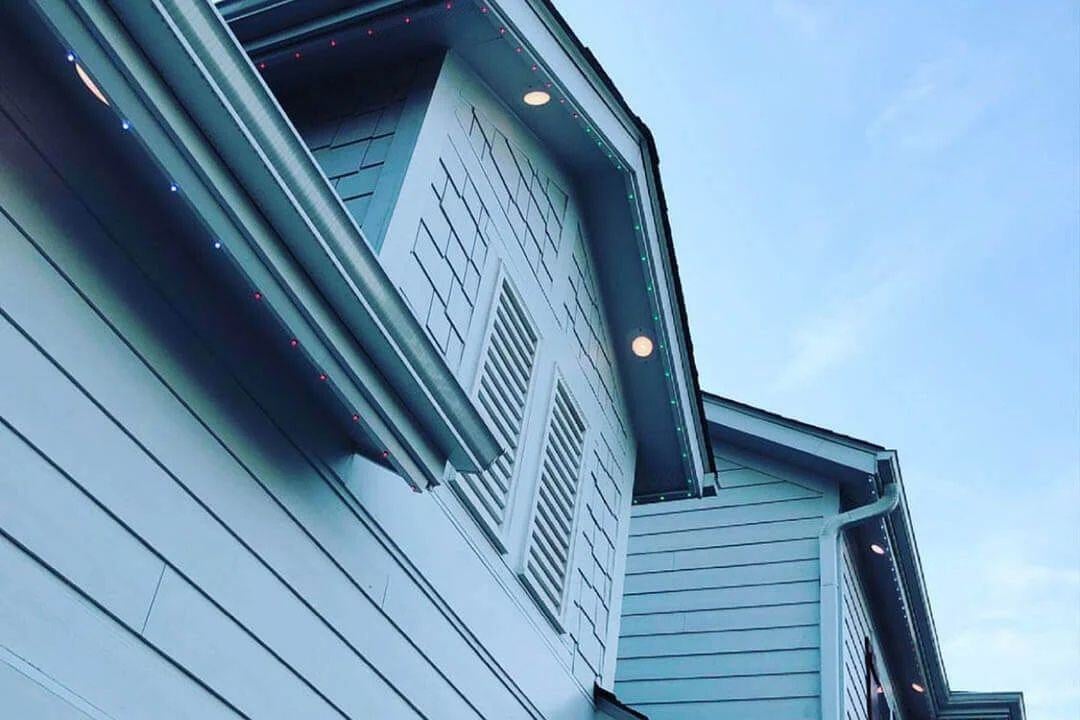
Every architectural feature brings its own set of questions. Here's how the most common ones affect a permanent lighting project and what to ask about each.
Roof pitch describes how many inches a roof rises for every 12 inches it runs horizontally. A gentle 4/12 slope and a sharp 12/12 slope can both be lit, but the steeper the rake edge, the harder it is for a technician to reach and work along it safely.
Because Trimlight's channel mounts to the trim rather than the shingles, the crew isn't walking the roof surface to fasten anything. What a steep pitch changes is the reach, the equipment, and the time each rake run takes. Our look at how permanent lighting interacts with your roof covers the mounting side in more detail.
A gable that tops out 30 feet above the lawn is one of the most striking places to put light, since it frames the whole house from the street. It's also the section that takes the most setup, because the peak is often well beyond the reach of a standard extension ladder.
Expect your dealer to plan access for these sections specifically. Depending on the height and the ground below, that may mean taller ladders, additional safety equipment, or a lift, which is part of why height shows up as added labor in a quote.
Multi-story homes also make self-measuring less reliable. Upper rooflines are easy to underestimate from the ground, so a professional measurement matters more here than on a single-story house. Our roofline footage calculator is a good starting point for a rough number before the dealer visit.
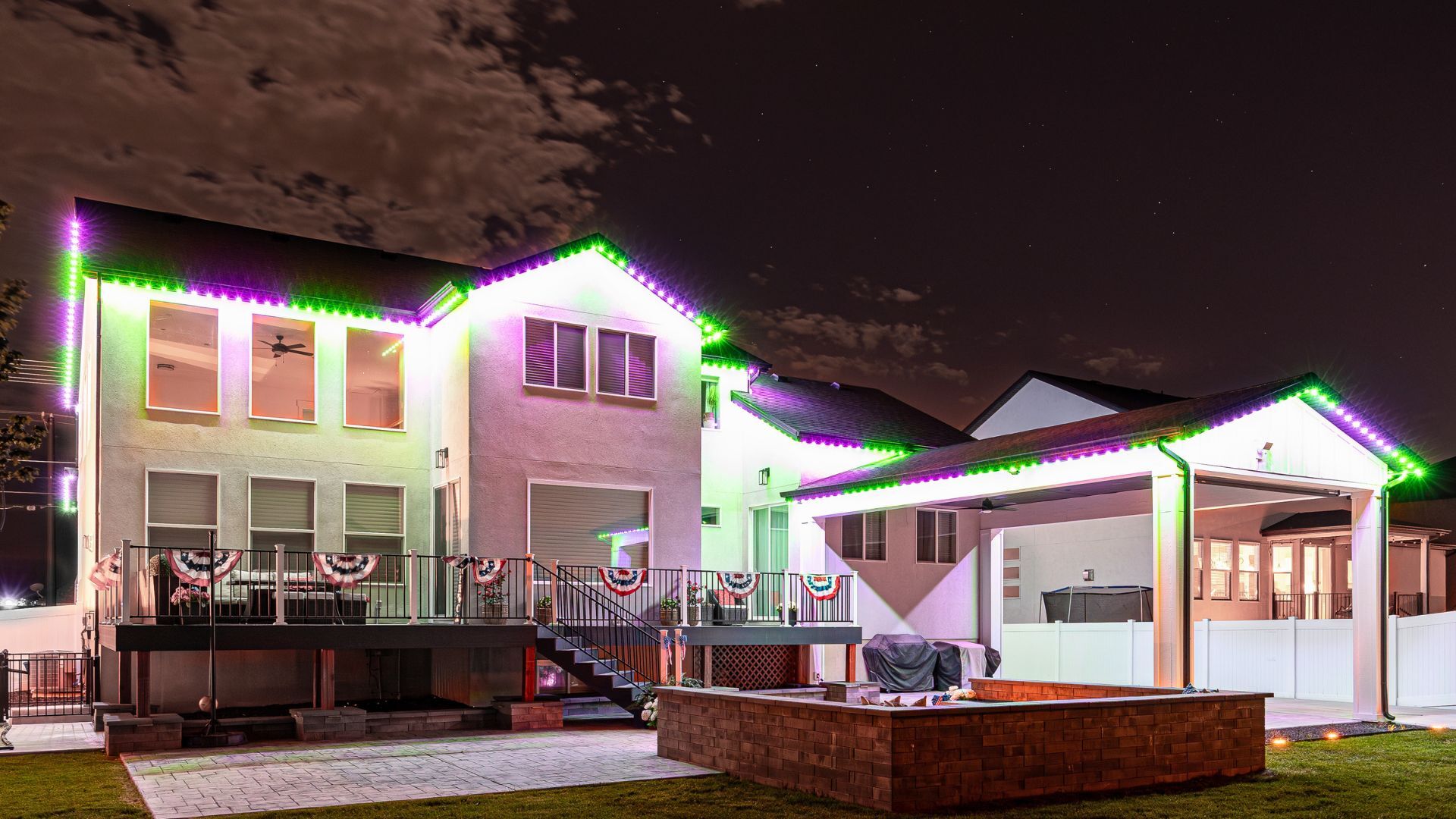
Every time the roofline changes height or steps in and out, the lighting becomes a new run. A home with three front dormers might have a dozen or more separate sections, each cut and fitted on its own. That's normal, and it's the main reason complex homes use more channel than their square footage suggests.
Hip roofs slope down on all four sides, which means level eaves wrap the entire house with few gables or peaks. They tend to be among the easier complex shapes to light, since the channel can follow the eave around each corner.
The main decision on a hip roof is how far around the house to go. Lighting only the front leaves the corners ending in open air, while wrapping the full perimeter gives a finished look from every side of the street.
Round turrets, curved eaves, octagonal bays, and angles well off 90 degrees are where the answer depends most on your specific home. Some of these can be lit with careful fitting, and others may be better left as an accent that stays dark while the lines around it glow.
Ask your dealer to walk these features with you rather than planning around them from a photo. They'll tell you which shapes the channel can follow cleanly and which ones would look better treated differently.
This is also a place where node spacing makes a visible difference. On architecture with many features, wider spacing can keep details from looking crowded, which is explained in our guide to choosing 6, 9, or 12 inch node spacing.
Spanish tile roofs, stucco walls, and flat roofs with parapets don't always have the kind of fascia board a roofline system is usually mounted to. These homes need an on-site look at the available mounting surfaces before a layout is set, so bring them up early in your first conversation with a dealer.
The real answer to "can my roofline be lit?" comes from someone standing in your driveway. Here's what that process looks like for a home with more going on than a single straight eave.
Your dealer will measure each run, note every height change, and check the mounting surface along each edge you want lit. On a complex home, this visit usually takes longer and covers more questions than on a simple ranch.
Come prepared with a sense of which views matter most to you, whether that's the street-facing front, the backyard patio, or both.
Complex homes give you more choices, not fewer. Many owners light the main eaves and the tallest front peaks, then skip rear dormers or secondary rooflines nobody sees from the street.
Others go for a full outline that traces every edge of the house. There's no wrong answer, and the dealer can show you how each option affects footage and cost.
If you're unsure, starting with the most visible lines and adding sections later is often an option. Just mention any future plans during the walkthrough so the first install is laid out with them in mind.
Installed pricing for a Trimlight roofline usually falls somewhere from $18 to $35 a foot, and most residential projects come in around $2,000 to $6,000 or more. Steep pitches, tall peaks, and many short runs push a project toward the higher end because they take more channel and more hours, not because the product itself changes. Our 2026 pricing breakdown goes through the other factors that move that number.
A system that looks great on a simple eave can look awkward on a home full of peaks and corners. Trimlight's design and its dealer network are built to keep complex homes looking clean.
Trimlight's patented channel is cut to length on site for each section of your roofline and color-matched to your trim. On a home with many short runs, that matters, because each piece blends into the architecture during the day instead of looking like a string of add-ons.
The wiring hides inside the channel, and the IP68-rated bulbs hold up on exposed peaks that take the brunt of wind, sun, and snow. You can see how that fitting works on install day in our roofline installation walkthrough.
Trimlight has been installing permanent lighting since 2010, and its more than 300 authorized dealers have worked on everything from ranch homes to towering multi-story gables. Every system carries a lifetime parts warranty, with dealers providing at least one year of labor coverage, so the extra effort that goes into a complex install is backed long after the crew leaves.
Yes. The sloped rake edges on each side of a gable are lit as their own runs of channel, climbing up to the peak. They're often the most eye-catching part of a complex roofline.
Yes. Your dealer can assess turrets, curved eaves, and unusual angles in person and recommend the cleanest approach.
Wider 12 inch spacing often suits busy architecture because it keeps features from looking crowded.
Yes. Hip roofs have level eaves on every side, so the lighting can wrap the full perimeter with few breaks.
No. The lifetime parts warranty works the same on any roof, and dealers provide at least one year of labor coverage regardless of height or pitch.
1 min read
Permanent outdoor lighting has turned into a crowded category, and Gemstone Lights is one of the names that comes up most often when homeowners start...
For most homeowners, the decision to move forward with permanent roofline lighting comes down to two questions: what does it look like when it is...
Building a custom home comes with a long list of wiring decisions. Where the outlets go, how many network drops each room needs, which wall the...