How Much Does Trimlight Cost? Full Pricing Guide for 2026
If you have been researching permanent holiday lighting and want a straight answer on what Trimlight actually costs, this guide gives you one....
9 min read
Most homeowners discover Trimlight through holiday lighting. But a growing number arrive from a completely different direction: they are looking for a better way to light their property for security, and they find that a permanent roofline LED system does the job more effectively than anything else they have considered.
Motion-sensor floodlights have been the default home security lighting solution for decades. They are familiar, inexpensive, and easy to install. They are also reactive by design, which creates a problem: a floodlight does nothing until something has already crossed into your yard. For homeowners who want consistent deterrence rather than an alarm after the fact, that reactive model is a fundamental limitation. Permanent LED security lighting for homes works on a different principle entirely.
The motion-sensor floodlight runs on a simple logic: detect movement, trigger light. For certain applications, that logic holds up. A driveway sensor that activates when you pull in at night is useful. But as a perimeter security strategy for a home, the reactive model has a core flaw that most homeowners only recognize after the fact.
Deterrence works before an approach, not during one. A well-documented finding across residential security research is that exterior lighting functions as a deterrent primarily when it makes a home look occupied, monitored, and consistently attended to. A property that sits dark until something moves reads as unmonitored. A property lit from dusk to dawn reads differently. Motion-sensor floodlights, by definition, spend most of their time off. That means the deterrence effect is intermittent at best.
Even a well-positioned floodlight covers a cone, not a perimeter. Most homes have blind spots where coverage drops off: the side gate, the stretch of yard between two fixtures, the rear corner of the garage. Filling those gaps with additional fixtures adds cost, creates inconsistent aesthetics, and still leaves edge cases where movement goes undetected long enough to matter.
The math on this compounds quickly. A home with four distinct access points needs at minimum four fixtures aimed and calibrated correctly, with enough overlap to eliminate dead zones at the edges of each coverage cone. In practice, most homeowners install two or three and live with the gaps because adding more starts to feel excessive. Those gaps are exactly what makes a property a more attractive target than a neighbor's with consistent perimeter lighting.
Permanent roofline LED lighting addresses coverage from a different starting point. Because nodes are installed at consistent intervals along the full roofline, available in 6 inch, 9 inch, and 12 inch spacing depending on the home and desired effect, the illuminated zone wraps the entire structure rather than spotlighting specific areas. There are no gaps by design, and no dark zones that only reveal themselves after dark.
Motion-sensor floodlights rely on replaceable bulbs, moving mechanical parts in the sensor housing, and connections exposed to weather year-round. Most homeowners have experienced the frustration of a floodlight that stopped triggering, a bulb that burned out unnoticed, or a sensor misfiring in cold weather. Trimlight's LED nodes are built for continuous use across years of exposure, with sealed weatherproof components and no moving parts to fail. When something does need attention, the lifetime product warranty covers the hardware.
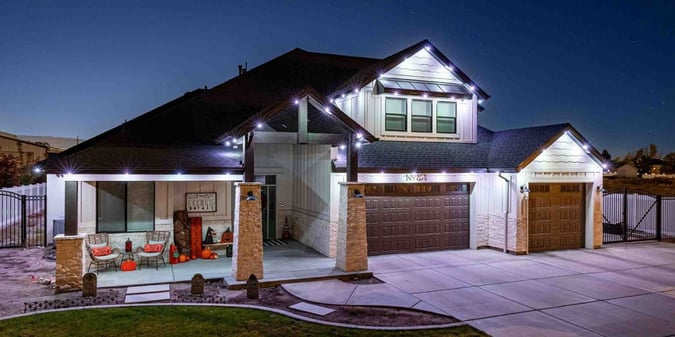
Understanding why roofline lighting works for security means looking at what it actually does on a given evening rather than how it compares on paper to other fixture types.
A home with Trimlight installed presents a fully lit exterior from the moment the system activates at dusk. The roofline itself, one of the most visible parts of a home from the street and neighboring properties, is outlined in continuous light. This creates an immediate visual signal that the property is occupied and monitored regardless of whether anyone is home. That consistent presence is the actual mechanism behind lighting-based deterrence, and it is something a motion-sensor system cannot replicate.
Homeowners frequently schedule their Trimlight system through the Edge app to activate automatically at sunset and shut off at a set time late at night, or to run at reduced brightness through the overnight hours. The scheduling runs without manual intervention, which means the home looks attended to whether the owners are home, traveling, or simply asleep.
Permanent LED systems offer control that fixed-output floodlights do not. Through the Trimlight Edge app, homeowners can set the color and brightness of their roofline lighting to match their security priorities. A bright white or warm white output maximizes visibility along the perimeter, while cooler color temperatures read as more alert from the street. Homeowners can increase brightness during extended periods away from home, reinforcing the occupied appearance without any manual action required. And when security is not the priority for the evening, the same system switches to a holiday display or any other color profile in a few taps.
Motion-sensor systems introduce two problems that persistent lighting eliminates entirely. The first is trigger delay: there is a period between when movement enters the detection zone and when the light activates, during which the perimeter is unlit. The second is false activations from animals, passing cars, or wind-moved vegetation, which can condition household members to ignore the lights over time, reducing their functional value as an alert signal.
A system that stays on eliminates both problems. There is no delay because the light is already active. There is no desensitization because the light does not flash on unexpectedly.
One reason homeowners who arrive through the security entry point often stay with Trimlight long-term is that they realize how much additional use they get from a single installed system. Security was the original need. What they end up with is significantly more.
Once a Trimlight system is installed for security purposes, the same hardware handles holiday displays across every occasion on the calendar. Christmas, Halloween, 4th of July, Valentine's Day, and any custom color combination the homeowner wants are available through the Edge app with no additional equipment and no seasonal installation work. Switching from a steady white security output to a full holiday display takes a few taps. For households that previously paid for annual installation and removal of seasonal lighting on top of maintaining separate security fixtures, folding both into one permanent system changes the financial picture considerably.
Security floodlights are utilitarian. They communicate function, not care. A permanent roofline LED system communicates both. From the street, a well-lit home with clean, consistent architectural lighting reads as well-maintained, attended to, and visually intentional, which is a different signal entirely than a pair of flood cans mounted above the garage.
Real estate professionals consistently note that exterior lighting condition is among the first things buyers register on an evening or early-morning drive-by. A home that is lit thoughtfully from the roofline down presents better at every hour, not just during showings. For a homeowner who purchased Trimlight for security reasons, the curb appeal benefit is largely automatic. The same consistent illumination that deters unwanted attention also makes the house look like someone cares about it.
There is also a neighborhood context worth considering. A home whose roofline is lit consistently and cleanly tends to raise the perceived attentiveness of an entire block. From a property value standpoint, a professionally installed permanent lighting system that doubles as a holiday display platform is a more compelling listing feature than a set of motion-sensor fixtures that any homeowner can put up themselves in an afternoon.
Trimlight installations are handled by factory-trained technicians through a network of more than 300 authorized dealerships. The process starts with a full perimeter assessment to determine node spacing and placement before anything goes up. That structured approach is a different experience from a homeowner mounting floodlights at intervals that seem reasonable at the time, and for a security-focused installation specifically, it matters: a gap in the roofline coverage is a cosmetic issue on the holiday side and a functional one on the security side.
For homeowners actively weighing the two options, the practical differences are worth examining directly rather than in the abstract.
Motion-sensor floodlights cover discrete zones. Roofline LED lighting covers the full perimeter continuously. For a property with multiple access points, a full perimeter system provides coverage that would require numerous individual floodlights to approximate and still leave gaps at the edges of overlapping detection zones.
The practical difference shows up most clearly on homes with side yards, detached garages, or rear access points. A floodlight aimed at the driveway does nothing for the back fence. A roofline system lit at consistent node intervals addresses every side of the structure from a single installation. There is no second conversation about where to add more fixtures because the perimeter is already covered.
A floodlight operates reactively. A permanent LED system operates on a schedule. The operational difference is significant for deterrence: consistent light on a schedule is harder for an intruder to predict, plan around, or test, compared to a reactive system whose trigger zone can be identified by observation over a short period.
There is also a behavioral component. Households that live with motion-sensor floodlights for several years often stop registering them. A light that activates when a cat crosses the yard at 2 a.m. becomes background noise. A light that is simply on every night, steady and consistent, does not produce the same desensitization. The signal stays meaningful because it never changes.
From a pure deterrence standpoint, the question a homeowner should ask is what the lighting looks like to someone approaching the property from the outside, not from the inside. A dark home with a floodlight that might activate looks different than a home with a fully lit roofline perimeter. The second one requires no interpretation about whether anyone is paying attention.
Floodlights involve ongoing costs: bulb replacement, sensor replacement as components age, and potentially full fixture replacement after several years of weather exposure. A Trimlight installation carries an upfront professional installation cost and then functions on the lifetime product warranty with no recurring replacement cycle. Residential projects typically run between $18 and $35 per linear foot depending on the home and configuration. For most homeowners, the total installation lands in the $2,000 to $6,000+ range depending on perimeter length and system specifics.
A floodlight does one thing. A permanent LED system does many things from the same hardware: security coverage, holiday displays, architectural accent lighting, event lighting, and curb appeal year-round. For homeowners who want infrastructure that earns its cost across multiple uses rather than a single-purpose fixture they will eventually replace, the distinction matters.
For homeowners approaching this from a security standpoint, a few practical considerations are worth raising before scheduling a consultation.
The Trimlight Edge app is the control layer for the entire system. Scheduling, color selection, brightness adjustment, and pattern selection all run through the app, and for security purposes the scheduling function is what most homeowners use first. Set the system to activate at dusk and run through the overnight hours, and it does exactly that every night without manual input. Remote access means homeowners can check or adjust the configuration from anywhere, which matters most when they are away from home for an extended stretch and want the property to look occupied without coordinating with anyone on-site.
Trimlight roofline systems are available in 6 inch, 9 inch, and 12 inch node spacing. Closer spacing produces denser, brighter output along the roofline and is generally preferred for properties where maximum visibility is a priority. Your Trimlight dealer will assess the home and recommend spacing based on perimeter length, architectural features, and the homeowner's primary goals for the system.
For homeowners prioritizing security output, 6 inch spacing typically makes the most sense. The denser node placement produces a brighter, more continuous band of light along the roofline that reads clearly from a distance and leaves no dim stretches between nodes. Homeowners who want a balance between security performance and a subtler daytime aesthetic often land on 9 inch spacing, which still provides solid perimeter coverage without the fully saturated look of the closest configuration.
For a security application specifically, installation quality is more consequential than it might be for purely decorative use. Dead zones, loose connections, or inconsistent node placement can create gaps in coverage that undermine the perimeter lighting strategy. Trimlight's factory-trained technicians are trained on installation standards that eliminate these issues, and the company's network of authorized dealers means professional installation is available across the country.
It is also worth noting that Trimlight has been doing this since 2010, longer than any other permanent LED lighting company in the industry. The installation process has been refined across thousands of residential properties and a wide range of home styles and climates. That depth of experience shows up in the details: how nodes are positioned around corners, how wiring is routed to stay clean and protected, and how spacing decisions get made for homes with unusual roofline geometry. These are not things a first-time DIY install handles well, and they matter more for a security-focused system than for a purely decorative one.
LED systems operate at a fraction of the energy draw of incandescent or halogen floodlights, so running a full roofline system through the overnight hours typically adds less to a monthly energy bill than most homeowners expect.
Bright white or warm white outputs tend to maximize visibility and produce the appearance of an actively lit, occupied property, though the Edge app allows full color control so homeowners can adjust based on preference or specific use.
Trimlight's LED components are built for continuous long-term use and backed by a lifetime product warranty, so homeowners are not managing a replacement cycle the way they would with conventional security fixtures.
Trimlight's lifetime product warranty covers the LED hardware, providing long-term coverage that conventional security fixtures sold with one- or two-year warranties do not offer; your authorized dealer can walk through the specific terms at consultation.
If you have been researching permanent holiday lighting and want a straight answer on what Trimlight actually costs, this guide gives you one....
1 min read
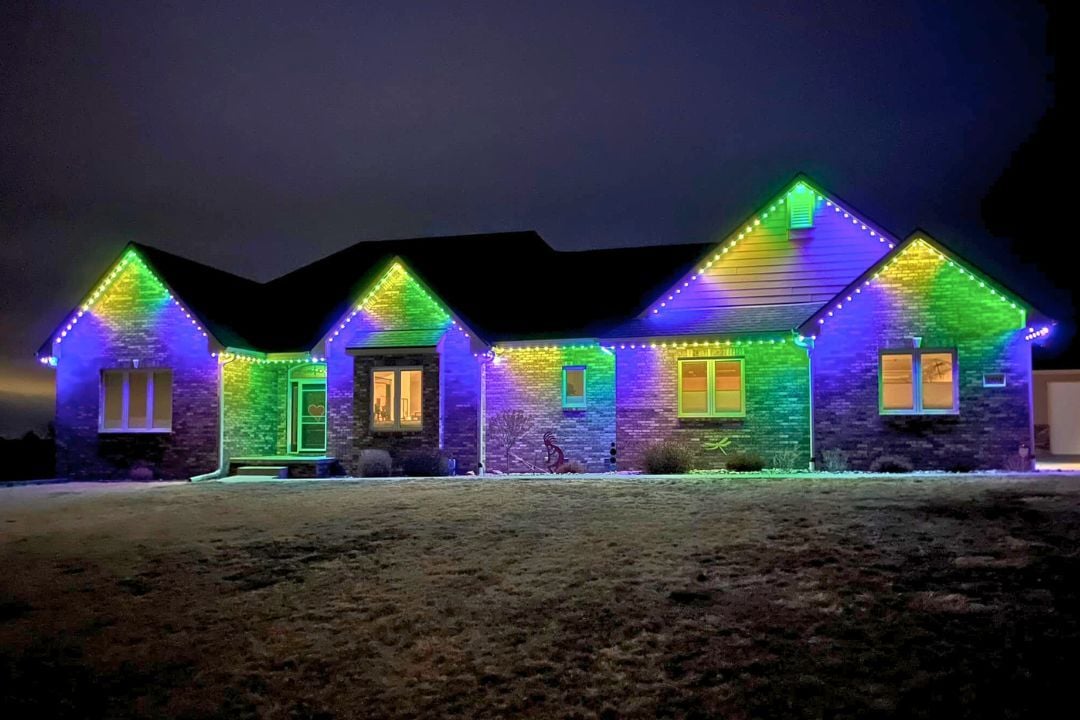
Mardi Gras is one of the most visually distinctive celebrations on the calendar — a season defined by bold color, festive energy, and the kind of...
Most people don’t realize how much time and energy they waste on temporary lighting until they stop doing it. The yearly cycle of buying, hanging,...