How Trimlight Mardi Gras Lights Can Help You Celebrate in Style
Mardi Gras is a time for celebration, excitement, and vibrant colors. It's a time to let loose, have fun, and indulge in the festivities with friends...
9 min read
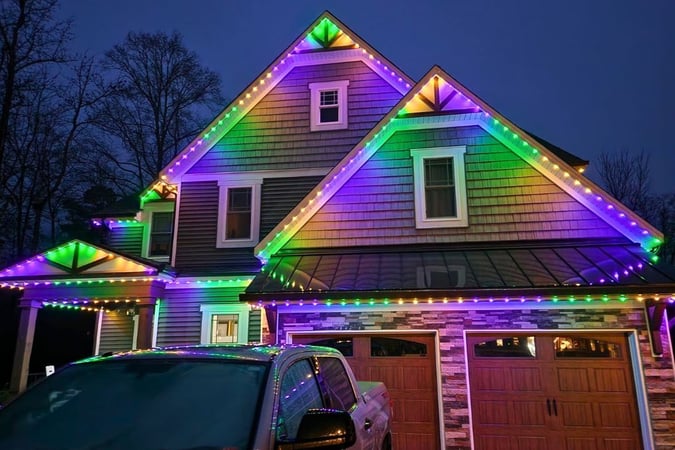
Mardi Gras is one of the most visually distinctive celebrations on the calendar — a season defined by bold color, festive energy, and the kind of neighborhood spirit that deserves to show up on the exterior of your home as loudly as it does inside. Purple, green, and gold have marked the Carnival tradition for over a century, and few things capture that energy from the street quite like a roofline lit in those colors on a crisp January or February evening.
With Trimlight’s permanent LED lighting system, you do not need to untangle a single strand of temporary lights, haul out a ladder, or dig through the garage for the right extension cord. The purple, green, and gold are already there, waiting in the app, ready to load in seconds. This guide covers the best Mardi Gras pattern ideas for permanent roofline lighting, the RGB codes to get each color right, and how to make the most of the season before Fat Tuesday arrives.
The purple, green, and gold of Mardi Gras are not arbitrary — they were formally assigned to the celebration in 1872 by the Rex organization in New Orleans and have carried symbolic meaning ever since. Understanding the tradition behind the colors makes building your lighting display feel less like a decoration project and more like participating in something with genuine cultural weight.
Purple represents justice in the Mardi Gras tradition. In lighting terms, it is the most dramatic of the three colors — deep and rich when rendered in LED, it anchors the display and gives it the sense of ceremony that Carnival demands. On the roofline, purple reads as bold and regal from the street, especially when paired with the warmer tones of gold on either side of it.
The specific shade matters more than most homeowners expect. A purple that leans too blue reads as cool and modern rather than festive. A purple that leans too red tips into magenta territory. The classic Mardi Gras purple sits squarely in the deep violet range — rich enough to carry weight from a distance, saturated enough to look deliberate rather than accidental. The RGB values in the section below are calibrated to land exactly there.
Green represents faith and brings a vivid, energetic contrast to the purple. In a rotating or chasing sequence, green is the color that makes the eye move — it has a brightness that catches attention from a distance and keeps the display from feeling static or heavy. The specific shade matters: a vivid, saturated green reads as festive and celebratory, while a muted or olive-toned green loses the Carnival character entirely.
Green also plays a structural role in the full palette that is easy to overlook when you are thinking about it as just one of three colors. Purple and gold without green produce a rich but heavy combination — regal but not quite festive. Add a vivid green and the display opens up visually, giving the eye a bright, high-energy point to land between the deeper tones. It is the color that makes the full Mardi Gras palette feel alive rather than just decorative.
Gold represents power and is the warmest of the three colors, bringing an amber richness to the display that softens the contrast between purple and green while still reading as bold from the street. In LED terms, gold is achieved by mixing red and green channels at specific values — getting it right produces a warm, glowing amber that looks unmistakably festive. Getting it wrong produces a dull yellow or a washed-out lime that drags the whole palette down.
Gold also reads differently depending on how far the viewer is from the home. Up close it has a warm, almost candlelit quality that feels refined. From a distance it holds its luminosity and reads as bright and celebratory against the deeper purple. The two gold values in the RGB section cover both situations — the warmer tone for close-range viewing and tighter rooflines, the slightly lighter alternate for larger properties where distance is a factor.
The pattern you choose determines the energy and character of the display. Here are five Mardi Gras pattern ideas that work well on a roofline, ranging from understated elegance to full parade-level festivity.
The simplest and most immediately recognizable Mardi Gras display: three equal sections of purple, green, and gold rotating slowly across the full length of the roofline in sequence. The rotation speed determines the mood — a slow cycle reads as regal and deliberate, matching the processional feeling of a parade. A faster cycle picks up energy and works well for evenings when activity around the neighborhood is high. This is the pattern that registers from the street instantly as Mardi Gras without requiring any explanation, and it is the easiest to set up and save in the Trimlight Edge app.
Use the Classic Mardi Gras Purple (102, 0, 153), Vivid Green (0, 153, 51), and Warm Gold (255, 185, 0) for the three zones. Start the rotation interval at three seconds per color and adjust from there based on how it reads from the street at your specific property. Wider rooflines tend to benefit from a slightly slower cycle; narrower ones can handle a faster rotation without feeling frantic.
Mardi Gras beads are the most iconic visual element of the season — strings of alternating purple, green, and gold beads thrown from parade floats to the crowd below. The Bead Strand Chase pattern replicates that look on the roofline by running a tight chasing sequence where individual LEDs cycle through the three colors in rapid succession, creating the impression of movement across the full length of the exterior. It is the most energetic of the Mardi Gras pattern options and works best on parade nights and on Fat Tuesday itself.
Pair the Deep Jewel Purple (75, 0, 130) with the Vivid Green (0, 153, 51) and Bright Celebration Gold (255, 200, 0) for maximum contrast in the chase sequence. The deeper purple holds its visual weight against the bright gold in a fast-moving pattern better than the lighter purple variation, which can wash out slightly at high chase speeds. Save this as a separate named pattern in the app so you can switch to it quickly on high-energy evenings without having to rebuild the settings from scratch.
This pattern alternates between a full roofline burst of gold and a full roofline burst of purple in a slow, pulsing rhythm — with green appearing briefly between each transition as a flash accent. The effect from the street mimics the flickering energy of parade lights and the warm glow of festival torches, producing a more dramatic impression than a standard rotation. It works especially well on larger rooflines where the scale of the display amplifies the pulse.
Set the pulse interval to between two and four seconds for the most natural rhythm. Shorter than two seconds edges toward strobe territory, which can be overwhelming from close range. Longer than four seconds loses the pulsing quality and starts to feel more like a slow rotation. Three seconds per color tends to be the sweet spot — each burst has enough time to land before the next one comes in.
A slower, more atmospheric pattern suited for evenings when you want the Mardi Gras energy present but not overwhelming. The Bourbon Street Fade transitions gradually between purple, green, and gold using a soft cross-fade rather than a sharp rotation, with each color holding for several seconds before dissolving into the next. The result is a warm, living quality to the display — less parade float, more lantern-lit balcony — that suits the quieter evenings of the Carnival season just as well as the loudest ones.
Use the Warm Gold (255, 185, 0) as the anchor color and let purple and green fade in and out around it, setting the hold time to five or six seconds per color before the transition begins. This is the pattern most homeowners end up using for the bulk of the season — switching to the Bead Strand Chase or Parade Night Pulse for specific high-energy occasions and returning to the fade for everything else.
For a clean, high-impact look that photographs well and reads clearly from the street without movement, divide the roofline into three equal zones and hold each zone in a static color: purple on the left third, gold in the center, and green on the right third. This creates a bold, symmetrical display that is immediately recognizable as Mardi Gras from any angle, holds up throughout the full Carnival season without feeling visually fatiguing, and pairs naturally with whatever else is going on around the exterior of the home.
Placing gold at the center works because it is the warmest and most luminous of the three colors — it draws the eye to the midpoint of the roofline first before letting it travel outward to the purple and green ends. Save this as your default Mardi Gras setting and use the more animated patterns as variations for specific occasions within the season. It is also the easiest display to describe to neighbors who stop to ask what you are running.
One of the features that makes Trimlight particularly well-suited for seasonal lighting is the scheduling capability in the Trimlight Edge app. Rather than manually switching to the Mardi Gras display every evening and back to your default setting each morning, you can program the entire Carnival season in advance with a date range that activates and deactivates the pattern automatically.
Set the Mardi Gras pattern to activate at sunset on the first day of Carnival season — traditionally January 6th, which is Kings Day or Epiphany — and schedule it to run through Fat Tuesday. After that date, the app automatically reverts to whatever default setting you have programmed, whether that is a warm white everyday accent or the next seasonal display on your calendar. You only have to set it once, and the season runs itself. For households that celebrate Mardi Gras seriously, this level of automation means the exterior of the home participates in the season from the first day to the last without any daily management from anyone inside it.
Most homeowners who want to display Mardi Gras colors on the exterior of their home face the same logistical problem every year: finding purple, green, and gold temporary lights that actually look good, hanging them on the roofline without a ladder disaster, keeping them working through February weather, and then taking everything down and storing it until next year. It is a project that competes with every other thing happening in January, and the results are rarely as vivid or as clean as what the season deserves.
Trimlight eliminates every part of that process. The hardware is already on the roofline, professionally installed and engineered to perform through winter weather without any seasonal removal or storage. The colors are already available in the app — every shade of purple, green, and gold you could want, dialed in with exact RGB values, saved as a pattern, and waiting to be activated with a tap. There are no ladders, no tangled strands, no extension cords running across the fascia, and no February teardown to dread when the celebration is over. The display goes up instantly and comes down just as easily, leaving the roofline in its clean everyday setting until next year. See our permanent Mardi Gras lighting page for more on what the system looks like in action.
Once the Trimlight system is installed for Mardi Gras season, it stays ready for every occasion that follows. St. Patrick’s Day calls for rich green across the full roofline. Valentine’s Day works in red and soft pink. Easter brings pastel combinations that the app handles as easily as the bold Carnival palette. The 4th of July, Memorial Day, and Flag Day are natural fits for red, white, and blue. Halloween, Thanksgiving, Christmas — the calendar fills itself, and the system handles every entry on it without new hardware, additional installation, or any effort beyond picking a pattern.
For many households in Mardi Gras country, the system pays for itself emotionally the first season — the combination of a genuinely vivid Carnival display, zero setup effort, and the knowledge that every future holiday is equally accessible tends to change how people think about exterior lighting entirely. The question stops being “should I bother hanging lights this year” and becomes “what are we running this weekend.”
Mardi Gras falls anywhere from early February to early March depending on the year, but Carnival season officially begins on January 6th with Kings Day. If you want the display running from the start of the season, the installation needs to be scheduled well before that date — ideally before the end of December or in the first days of January at the latest. Installation demand is highest in November and December around the Christmas season, which can push scheduling timelines into January for late requesters. The earlier the consultation is requested, the more scheduling flexibility your local dealer has to work with.
For homeowners who are new to Trimlight and considering the system primarily for Mardi Gras, the value becomes apparent quickly once the broader holiday and occasion calendar comes into view. A system installed in January for Mardi Gras is also ready for Valentine’s Day four weeks later, St. Patrick’s Day a month after that, and every occasion from Easter through next year’s Mardi Gras without a single additional installation visit required. The investment in a January installation covers considerably more than a single season of purple, green, and gold.
For classic Mardi Gras colors: Purple is R:102, G:0, B:153 — Green is R:0, G:153, B:51 — Gold is R:255, G:185, B:0. Alternate deeper purple: R:75, G:0, B:130. Alternate brighter gold: R:255, G:200, B:0.
Visit Trimlight.com to locate an authorized dealer near you — they handle everything from the initial estimate to the finished installation.
It is well established in criminology that consistent exterior lighting deters property crime by removing the cover of darkness and signaling that a home is active and occupied. Trimlight's system means there are no gaps in coverage and no dark nights that leave your property more vulnerable.
Connect with a certified Trimlight dealer near you and they'll design a lighting experience built specifically around your home and lifestyle. You can also request a free, no-obligation quote online and start your journey toward a home that truly feels like a sanctuary the moment it comes into view.

Mardi Gras is a time for celebration, excitement, and vibrant colors. It's a time to let loose, have fun, and indulge in the festivities with friends...
Thinking about getting permanent outdoor Christmas lights in July might seem early, but it is the perfect time to decide. A Trimlight system is not...
1 min read
If you have ever found yourself untangling extension cords in a cold garage in November, or balancing on a ladder in December to swap out a single...