1 min read
What Is Permanent Holiday Lighting? A Complete Guide for Homeowners
If you have ever found yourself untangling extension cords in a cold garage in November, or balancing on a ladder in December to swap out a single...
12 min read
There is a conversation happening around your home every single night, and you are not part of it. Neighbors driving past, guests pulling into the driveway, potential buyers doing casual evening drive-bys — all of them are drawing conclusions about your home and the person who lives in it based entirely on what they can see after dark. And what they see, or fail to see, is processed not by their conscious mind but by the part of the brain that works faster than thought, pattern-matching everything in the environment against stored associations about care, quality, and follow-through. Trimlight's permanent LED lighting was built to make sure that conversation always ends in your favor, automatically, every night, through a set of subconscious cues that communicate everything about your home's maintenance standards without a single word being spoken.
Human beings are extraordinarily fast at reading environments. Neuroscientists studying visual processing have documented that the brain begins categorizing and responding to environmental stimuli within milliseconds of exposure, long before the conscious mind has formed a single deliberate thought about what it is seeing. This speed is not a quirk. It is a survival mechanism that evolved over hundreds of thousands of years, and it operates through a process of pattern recognition that compares incoming visual information against stored associations built up through a lifetime of experience with how maintained and unmaintained environments look and feel.
When that pattern recognition process encounters a residential exterior after dark, it is doing something very specific. It is looking for signals that tell it whether this environment is ordered or disordered, attended to or neglected, invested in or abandoned. Those signals are processed and evaluated instantly, and they produce an emotional and cognitive response that shapes everything the observer thinks and feels about the property from that point forward, including the conclusions they draw about the person who lives there and the standard to which the home is maintained. The brain does not wait for more information. It draws its conclusions from what is immediately available, and what is immediately available after dark is almost entirely determined by the quality of the home's exterior lighting.
Exterior lighting is one of the most legible of all the signals the brain reads in this process, because it is either present or it is not. A dark home registers as disordered, absent, and unattended to at exactly the neurological level where maintenance impressions are formed. A home with consistent, intentional led lights for a house registers as ordered, present, and cared for at that same level. The difference between those two readings is not a matter of opinion or preference. It is a matter of how the brain is wired to process environmental information, and Trimlight is built to ensure that the reading it produces is always the favorable one.
What makes this particularly significant for homeowners is that these neurological readings are not correctable after the fact. An observer who processes a dark home subconsciously as unattended to does not then revise that conclusion when they learn that the homeowner is actually very diligent about maintenance. The subconscious impression sticks, because it was formed at a level of processing that rational information has very little power to reach. The only way to send the right signal is to ensure it is present in the first place, which is exactly what Trimlight's permanent LED lighting makes possible every single night without exception.
In cognitive psychology, the halo effect describes the tendency for a strong positive impression in one area to influence judgment across unrelated areas. It was first formally documented by psychologist Edward Thorndike in the early twentieth century and has since been replicated across hundreds of studies spanning every domain from employment decisions to product evaluation to real estate. The halo effect is not a bias that careful thinkers avoid. It is a fundamental feature of how the human brain processes complex environments by using visible information to fill in what cannot be seen, and it operates on residential properties with exactly the same power that it operates everywhere else.
When applied to residential exteriors, the halo effect works like this: a homeowner whose property is consistently well lit, well presented, and visually intentional after dark triggers a favorable halo that extends across every aspect of the property the observer has not seen. They assume the roof has been maintained. They assume the systems inside the home are in good working order. They assume the interior reflects the same standard of care that the exterior is displaying. They assume that when something breaks, it gets fixed promptly. None of these assumptions are based on direct evidence. They are based entirely on the halo cast by the one thing that was visible: the quality and consistency of the exterior lighting.
This makes the quality of outdoor accent lighting for home one of the highest-leverage maintenance signals a homeowner can control, because it does not just communicate something about the lighting itself. It communicates something about everything. A home with Trimlight's architectural lighting integrated cleanly along the roofline is not just a home that looks well lit. It is a home that looks well maintained in every dimension, and that impression is formed automatically by every observer who sees it, without them ever having to consciously think about why they feel that way or what evidence they are basing it on.
The inverse halo works just as powerfully, and it is just as automatic. A home that is dark after dark, or whose exterior lighting is inconsistent or incomplete, triggers a negative halo that extends the impression of inattention across every part of the property. Observers who see a dark exterior do not just conclude that the lighting is inadequate. They conclude, subconsciously and automatically, that the home is probably not as well maintained as a well-lit one would be. That conclusion influences buyer decisions, neighbor perceptions, guest impressions, and the overall standing of the property in the community it belongs to, all based on a reading that took less than a second to form.
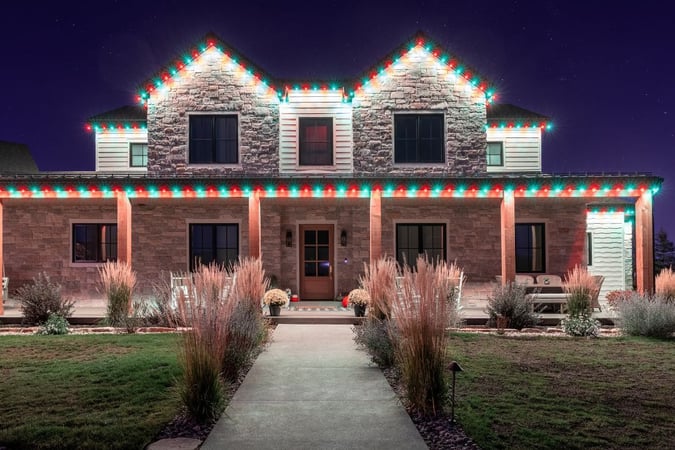
Attribution theory is a branch of social psychology that studies how people explain the behavior and characteristics of others based on observable evidence. When applied to the residential context, it describes a process that most homeowners have never considered: the way that observers attribute personality traits, values, and character qualities to the person who owns a home based entirely on how that home presents itself after dark. This is not a process that requires acquaintance with the homeowner, knowledge of their habits, or any direct interaction with them. It happens entirely through the visual evidence that the property itself provides.
A home with consistent, beautiful outdoor Christmas lights for house and year-round architectural lighting does not just signal that the homeowner has good taste. It signals, at a subconscious level, that the homeowner is the kind of person who follows through, who thinks about how things look over time rather than just in the moment, who invests in quality rather than settling for convenience, and who holds their environment to a standard that reflects their values. These attributions happen automatically and without any deliberate effort on the part of the observer. They are the natural result of how the brain uses visible evidence to draw conclusions about invisible character, and they attach themselves to the homeowner's reputation in the neighborhood whether the homeowner is aware of it or not.
Conversely, a home without intentional exterior lighting triggers a different and less favorable set of attributions. The observer does not consciously think that the homeowner is inattentive. They simply feel, at a level below conscious thought, that this home and by extension its owner do not inspire the same confidence that a well-lit home does. That feeling influences how they interact with the homeowner, how they evaluate the property, how they talk about it to others, and how seriously they take it as a candidate for purchase or investment. The attribution is never spoken aloud. It simply shapes behavior in ways that accumulate over time into real and tangible consequences for the homeowner's reputation and the property's standing.
Trimlight's permanent LED lighting takes the attribution process out of the homeowner's hands and puts it on autopilot in the best possible direction. Every night the system is active, it is making automatic and favorable attributions on behalf of the homeowner without requiring any action or awareness from the person who lives there. The lighting is doing the character work quietly and continuously while the homeowner goes about their evening, and it is doing it with the kind of consistency and reliability that makes those attributions not just form but stick.
Most homeowners with unlit or inconsistently lit exteriors do not think of themselves as sending a signal. They think of themselves as simply not having gotten around to addressing the lighting yet, or as not having made it a priority, or as planning to handle it eventually when the time is right. What they do not realize is that the absence of intentional exterior lighting is itself a signal, a powerful and persistent one, and it is being received and interpreted by every person who sees the home after dark whether the homeowner intended to send it or not.
Darkness, in the context of a residential exterior, does not register as neutral to the observing brain. It registers as absence, and absence in a context where presence is expected reads as a form of neglect. The brain has built up a set of expectations about what a well-maintained, actively inhabited home looks like after dark, and intentional exterior lighting is a central part of that expectation. When that expectation is not met, the brain does not simply note the absence and move on. It fills the gap with an interpretation, and the interpretation it reaches automatically is not a charitable one. It does not conclude that the homeowner simply has not gotten around to the lighting. It concludes, below the level of conscious thought, that this is a home where things do not get addressed, where the gap between intention and follow-through is wide, and where the standard of care is lower than it appears during the day.
This subconscious conclusion cascades into every other impression the observer forms about the property. The landscaping looks less intentional. The paint color seems less deliberate. The overall sense of the home as a cared-for, invested-in property diminishes, not because any of those things have actually changed, but because the lighting that would have framed them favorably is absent. A dark home is not just missing its lighting. It is missing the interpretive context that makes everything else about it readable as evidence of maintenance and care, and without that context, even genuinely well-maintained features fail to register as such.
Trimlight's outdoor security lighting and architectural roofline replace that absence with a presence that is unmistakable and unambiguous. The home is there. It is lit. It is attended to. And every person who sees it after dark receives that message without having to look for it, because the lighting makes it impossible to miss and impossible to misinterpret. The signal is clear, consistent, and always working in the homeowner's favor.
Not all exterior lighting sends the same subconscious signals about home maintenance, and the difference between a professionally installed permanent system and seasonally clipped Christmas lights for house exteriors is not just a matter of aesthetics. It is a matter of communication. The way a lighting system is installed carries its own distinct layer of meaning that observers process alongside the light itself, and that meaning either reinforces or actively undermines the maintenance signals the homeowner is trying to send.
A temporary lighting approach, no matter how carefully executed in the moment, carries visible evidence of its temporariness. The clips on the gutters, the extension cords running along the foundation line, the slight unevenness in spacing where the installation was done quickly by hand in cold weather: all of these details register subconsciously as signals of impermanence. They communicate that the homeowner has made a seasonal effort rather than a lasting commitment, and that distinction matters to the brain's maintenance assessment in ways that are genuinely difficult to overcome through the quality of the light output alone. The brain sees the impermanence of the method and draws conclusions about the permanence of the homeowner's standards.
Trimlight's architectural lighting integrated directly into the home's trim and roofline by a professional sends an entirely different message. There are no visible clips, no extension cords, no signs of seasonal effort or temporary thinking. The lighting looks like it was always there because it was designed to always be there, and that permanence reads subconsciously as exactly the kind of long-term commitment that observers associate with a home that is genuinely and consistently well maintained.
The precision of the installation matters on its own terms as well. Trimlight's even, architectural coverage of the roofline and eaves creates a visual coherence that signals professional attention to detail at a level that observers recognize and respond to without being able to articulate exactly why. A home that looks like a professional made careful, deliberate decisions about every aspect of its exterior presentation is a home that the observer automatically assumes has received the same professional attention in every other area of its maintenance history. That assumption is the halo effect and attribution theory working together in real time, and Trimlight's installation triggers both of them simultaneously, every night.
The subconscious cues that Trimlight sends about home maintenance are not received only by outside observers. The homeowner is an observer of their own home too, and the visual environment they come home to every evening shapes their internal relationship with the property in ways that have real and lasting consequences for how the home is maintained over time. This dimension of Trimlight's impact is one of the least discussed and most significant, because it operates entirely below the level of conscious awareness and compounds over months and years into a meaningfully different approach to home ownership.
Environmental psychology has documented a well-established dynamic in which the visible standard of a person's environment influences their behavior within it. A space that looks well maintained tends to be better maintained going forward, because the visible standard it presents creates an internalized expectation that the occupant works, often unconsciously, to uphold. A space that looks neglected tends to attract further neglect for the same reason: the visible standard is low, and the brain does not feel the same cognitive pressure to elevate it. This dynamic plays out in offices, in public spaces, in schools, and in homes, and it is just as powerful in a residential context as it is anywhere else.
When a homeowner installs Trimlight and begins coming home every evening to a beautifully lit, architecturally coherent exterior, something shifts in their internal relationship with the property. The home looks like a home that is taken seriously, and that impression is received by the homeowner themselves every time they pull into the driveway. It raises their own subconscious expectation for what the home should look like, which in turn motivates more attentive care across every other aspect of the property. The lawn gets addressed a little more promptly. The touch-up paint gets done before the season changes. The small repairs that could wait get handled because the overall standard of the home no longer makes waiting feel acceptable or consistent with the level of care the exterior is already communicating.
This is the internal feedback loop that Trimlight creates without anyone deliberately designing it. The outdoor christmas lights for house and year-round architectural roofline lighting that illuminate the home every evening are not just sending signals outward to neighbors and guests and potential buyers. They are sending a signal inward to the homeowner, reinforcing a standard of excellence that elevates the entire property over time. Trimlight does not just make a home look better maintained to the outside world. Over time, through this quiet internal mechanism, it actually makes the home better maintained, because the signal it sends to the person who lives there turns out to be just as consequential as every signal it sends to everyone else.
Every home is communicating something after dark. The question every homeowner should be asking is not whether their home is sending subconscious cues about its maintenance standards, but whether those cues are accurate, favorable, and consistent with the investment they have made in the property. For most homeowners with unlit or inconsistently lit exteriors, the honest answer is that the cues their home is sending do not reflect the care they put into it during the daylight hours. The maintenance story their home tells after dark is not the one they would choose to tell if they were thinking consciously about what every observer is receiving and concluding.
Trimlight changes that authorship entirely. It gives the homeowner control over the subconscious maintenance narrative their home broadcasts every evening, replacing absence with presence, inconsistency with reliability, and the passive signal of a dark exterior with the active, credible, automatically delivered signal of a home that is genuinely, visibly, and permanently well cared for. The permanent LED lighting system that traces the roofline and frames the architectural features of the home does not just illuminate the exterior. It tells the right story about it, every single night, to every single person who encounters it, at the exact level of subconscious processing where maintenance reputations are built and sustained.
From the warm architectural glow of led lights for a house on a quiet weeknight, to the rich seasonal character of christmas lights for house programming in December, to the year-round presence of outdoor accent lighting for home that makes the home look designed rather than merely decorated, Trimlight ensures that every subconscious cue your home sends about its maintenance is the right one. Not sometimes. Not in certain seasons. Every night, without exception, for as long as the system is installed and the conversation around your home continues.
The halo effect causes a positive impression in one visible area to extend across all unseen areas, meaning that consistently beautiful permanent outdoor lighting causes observers to assume the entire property is equally well maintained.
It does, even if that is not the homeowner's intention. A dark exterior registers subconsciously as absence and inattention, causing observers to draw unfavorable conclusions about the home's overall maintenance that are very difficult to reverse once formed.
Because the visible evidence of impermanence, the clips, the cords, the seasonal gaps, registers subconsciously as a short-term effort rather than a long-term commitment. Trimlight's led permanent lights integrated into the architecture communicate the opposite: a deliberate, permanent decision about the standard to which the home is maintained.
It may matter even more, because evening drive-bys are how many buyers and neighbors form their lasting first impressions of a property. A home with consistent led lights for house exterior makes just as strong an impression at night as a well-landscaped lawn does during the day.
Professional installation of permanent LED lighting communicates a level of intentionality and quality that DIY or seasonal approaches cannot replicate, because the permanence and precision of the installation itself is part of the subconscious signal the home sends about its overall maintenance standard.
1 min read
If you have ever found yourself untangling extension cords in a cold garage in November, or balancing on a ladder in December to swap out a single...
1 min read
Most homeowners spend more time thinking about interior lighting than exterior lighting, and then wonder why the outside of their home feels...
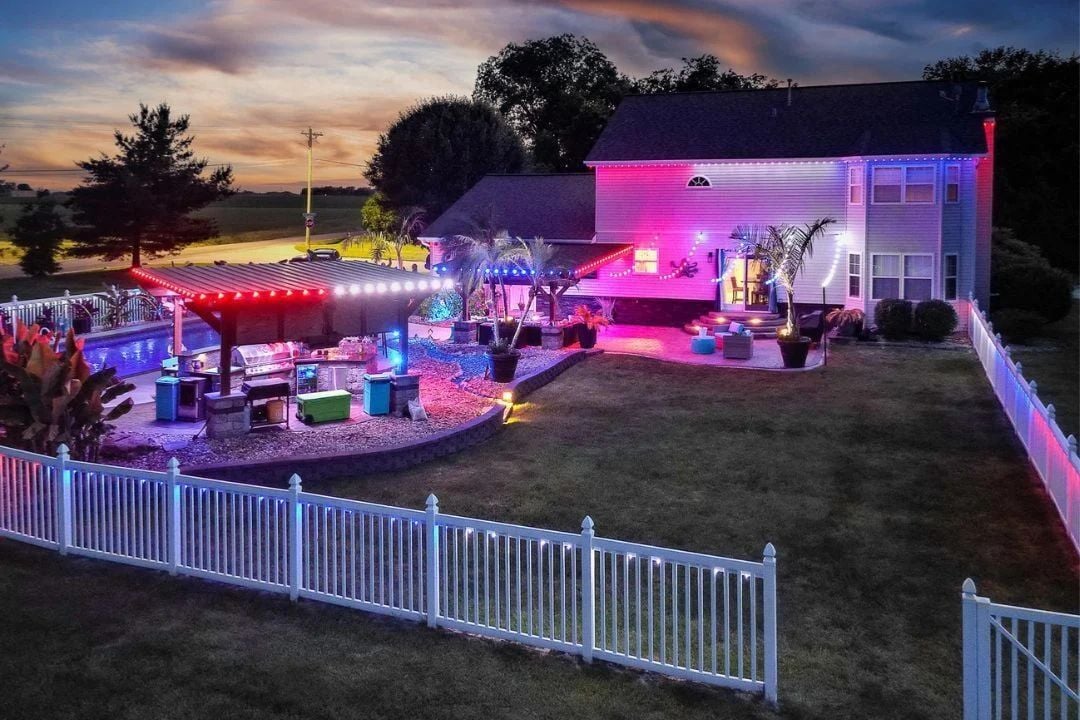
Trimlight fence edge lighting lets homeowners turn a simple fence into something memorable. Instead of just serving as a boundary, your fence can add...