12 Creative Uses of Trimlight Downlighting
Trimlight downlightingis a versatile and captivating addition to any exterior lighting setup. With its sleek design and customizable features, it has...
9 min read
Outdoor downlighting is one of those exterior features that is easy to overlook until you see it done well — at which point it is difficult to imagine not having it. Unlike roofline lighting that traces the outline of the home or landscape lighting that works at ground level, downlighting projects illumination downward from an elevated position, washing surfaces, pathways, and architectural features in a controlled, directional glow. The effect is elegant without being dramatic, functional without being harsh, and versatile enough to serve a home differently depending on the occasion.
Trimlight downlighting takes this concept and makes it programmable. Rather than fixed warm white fixtures that do the same thing every night, Trimlight’s surface-mounted downlighting system integrates directly with the Trimlight app, giving homeowners full control over color, brightness, patterns, and scheduling. Whether the goal is a refined everyday ambiance, a bold holiday display, or consistent security lighting after dark, the same hardware handles all of it — without rewiring, without cutting into surfaces, and without calling a contractor every time the look needs to change.
Downlighting refers to any lighting fixture that directs its output downward rather than upward or outward. In an exterior context, this typically means fixtures mounted on eaves, soffits, fascia, pergola beams, or other overhead surfaces — positioned to cast light onto the area below rather than into the sky or horizontally across a surface. The downward direction of the light creates a natural, shadow-free illumination that works well for pathways, entry areas, outdoor living spaces, and the surfaces of the home itself.
The distinction between downlighting and other forms of exterior lighting matters for understanding what each approach is best suited to. Roofline lighting traces the architectural outline of the home and is primarily a visual statement from the street. Landscape Uplighting works from the ground and projects light into trees and garden features from below. Downlighting fills the spaces in between — it provides functional illumination at the level where people are actually moving and spending time, while also creating a layered lighting composition that makes the full exterior feel designed rather than partially addressed.
Trimlight’s downlighting system adds a programmable dimension to this that standard soffit or canned exterior fixtures do not offer. Because the system connects to the same app as the rest of the Trimlight product line, the downlighting can be adjusted in real time, set to automated schedules, and customized with color and pattern options that fixed-color traditional fixtures simply cannot provide.
Most exterior downlighting options give homeowners a fixed result — warm white, always on, always the same. Trimlight approaches the product differently. The downlighting system is surface-mounted for flexible installation, integrates directly with the rest of the Trimlight ecosystem, and is fully programmable through the same app that controls the roofline lighting. Three things distinguish it from what most homeowners are comparing it to when they start researching exterior downlighting options.
One of the most practical features of the Trimlight downlighting system is how it installs. Traditional soffit lighting or canned exterior fixtures require cutting into the surface material, accessing the cavity behind it, and hardwiring the fixture into the electrical system — a process that typically involves a licensed electrician and a fair amount of disruption to the existing exterior. Trimlight downlighting is surface-mounted, meaning it attaches directly to the exterior surface without any need to cut openings, remove materials, or run new wiring behind walls.
This surface-mount approach makes the system significantly more flexible in terms of where it can be installed. Any exterior surface that provides a stable mounting point — eaves, fascia boards, pergola beams, porch ceilings, garage overhangs — becomes a viable installation location without the structural constraints that traditional recessed lighting imposes. For homeowners who want downlighting in locations where cutting is not practical or desirable, this is a meaningful advantage over conventional approaches.
Trimlight downlighting is designed to work alongside the existing Trimlight permanent holiday lighting system, not as a standalone addition that requires separate management. The downlighting uses its own controller but connects through the same Trimlight app, which means homeowners who already have roofline lighting installed can add downlighting coverage to their exterior without introducing a second app or a second control interface to manage.
The two systems can be programmed independently of each other, which is a useful feature in practice. You might run the roofline in a bold holiday pattern while keeping the downlighting in a warm, steady setting for ambient illumination below. Or you might sync both systems to the same color scheme for a fully coordinated exterior on a special occasion. The app makes both options equally straightforward, and switching between configurations takes a matter of seconds rather than requiring any physical adjustments to the hardware.
Like the rest of the Trimlight product line, the downlighting system offers programmable color and pattern options through the app. Millions of color combinations are available, brightness is adjustable across the full range from subtle ambient glow to vivid display lighting, and patterns can be saved and scheduled to run automatically on specific dates or at specific times of day. A homeowner can program the downlighting to come on at sunset in warm white every evening, shift to red and green for Christmas, cycle through pastels for Easter, or run team colors on game day — without doing anything beyond setting the schedule once.
This programmability is what separates Trimlight downlighting from standard exterior fixtures in a practical sense. A fixed warm white soffit light does one thing well. A programmable downlight with full color and pattern capability does many things well, adapting to the needs of the household and the occasions on its calendar rather than holding a single configuration indefinitely regardless of what is happening around it.
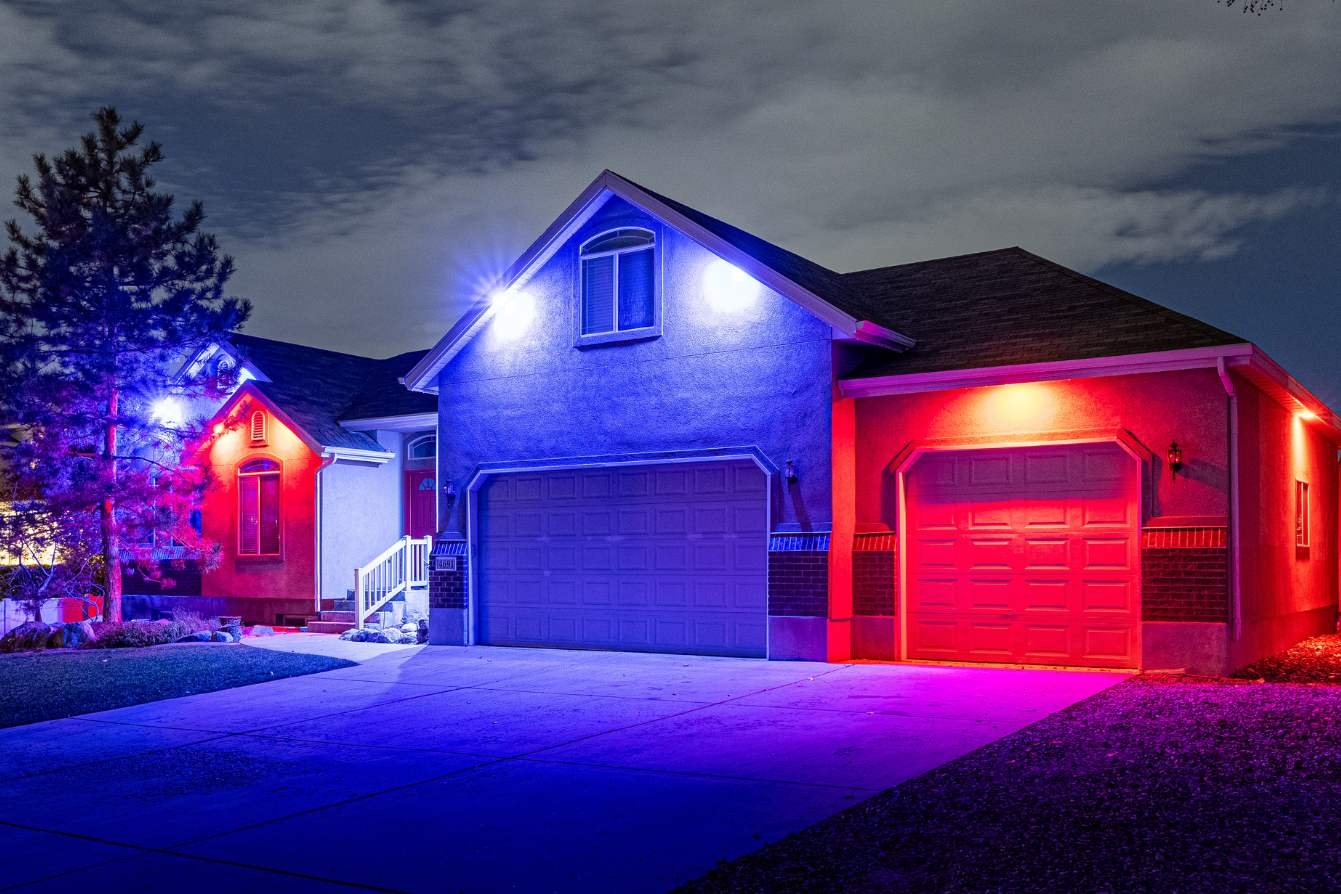
Downlighting is a genuinely versatile exterior feature, and part of understanding its value is seeing the range of locations where it delivers meaningful results. Here are the areas of a home’s exterior where it tends to have the most impact.
Downlighting placed along the eaves and overhangs of a home draws attention to the architectural features of the roofline in a way that roofline lighting alone does not. While roofline LEDs trace the horizontal outline of the home, downlighting from the eaves washes the surfaces below — the fascia, the siding, the upper section of the exterior wall — in a directed glow that emphasizes the depth and craftsmanship of the roofline structure. Gables, overhangs, and architectural details that might go unnoticed during the day become deliberate focal points after dark.
The combination of roofline lighting and downlighting together creates a layered effect that neither achieves alone. The roofline lighting defines the shape of the home; the downlighting gives that shape depth and dimension. For homeowners who want their exterior to look genuinely architectural rather than simply illuminated, the two systems working together produce a noticeably more complete result.
The entry is where every guest’s experience of the home begins, and lighting that makes it easy to navigate and visually inviting after dark does work that goes beyond aesthetics. Downlighting positioned above a front door or porch creates a soft, welcoming glow that guides people to the entry point without the harshness of a direct overhead fixture or the limitations of a single porch light. Customizable brightness means the same downlighting that provides practical visibility for a winter evening can be softened to a warmer, more atmospheric setting for a dinner party or gathering.
Downlighting from eave-level positions can reach garden beds, foundation plantings, and landscape features that sit close to the home, washing them in a downward glow that highlights their shapes and textures in a way that feels natural rather than spotlit. The effect is different from traditional landscape uplighting — rather than projecting light up into a tree or shrub from the ground, downlighting from above mimics the quality of natural light and creates a softer, more integrated result. Shrubs, flower beds, and architectural plantings close to the home benefit particularly from this treatment, as it connects them visually to the lit exterior above rather than treating them as isolated features.
Illuminating the path between the driveway or street and the front door is one of the most functional applications of exterior downlighting. Rather than installing separate ground-level pathway markers — which require their own wiring, their own maintenance, and their own management — downlighting from an overhead position can cover the same ground from above. Steps, uneven surfaces, transitions between materials, and the approaches to entry points all benefit from the consistent, shadow-reducing illumination that downward-facing lights provide from an elevated position. And because Trimlight downlighting is controlled through the same app as everything else, the pathway lighting adjusts automatically with the rest of the exterior rather than operating on a separate system.
Outdoor living spaces present one of the clearest use cases for programmable downlighting. An overhead downlight in a covered patio or pergola provides the functional illumination that makes the space usable after dark — enough light to see clearly, move safely, and engage with the space without squinting at dark corners. But with color and brightness control through the app, that same overhead light can shift from bright functional illumination for a gathering to a dim, warm setting for a quiet dinner to a vivid color display for a holiday party — all without changing anything physical about the installation.
This flexibility is particularly valuable for homeowners who use their outdoor living spaces for different purposes on different evenings. Fixed-color exterior lighting handles one scenario well and everything else adequately at best. Programmable downlighting handles every scenario intentionally, adjusting to the mood, the occasion, and the number of people using the space at any given time.
The programmable nature of Trimlight downlighting means it is never locked into one look. Where standard exterior fixtures do the same thing on a Tuesday in February as they do on Christmas Eve, downlighting with full color and pattern control responds to whatever is happening on the calendar. Here is how that plays out across the occasions that come up most often.
Programmable color makes downlighting a natural complement to any holiday display. Red and green for Christmas, orange and purple for Halloween, red and white for Valentine’s Day, warm gold for Thanksgiving — the downlighting can shift to match every major occasion on the calendar through a quick app adjustment or an automated schedule set up in advance. For homes that already have Trimlight roofline lighting, coordinating both systems to the same holiday theme creates a cohesive exterior effect that reads from the street as a deliberate and well-considered design rather than individual lighting elements doing separate things.
Team colors are one of the most popular recurring uses for programmable exterior lighting, and downlighting adds a dimension that roofline lighting alone does not cover. While the roofline displays team colors across the outline of the home, downlighting from the eaves washes the surfaces below in matching hues — the combined effect turning the full exterior of the home into a coordinated display that is visible well down the street. Loading a team color combination takes seconds in the app, and saving it as a recurring schedule means it can be set to activate automatically on game day without the homeowner having to think about it.
Customized lighting patterns add a layer of atmosphere to outdoor gatherings that fixed exterior lighting simply cannot match. Chasing sequences, pulsing colors, and dynamic patterns create energy for parties and celebrations; softer, slower transitions or steady warm settings create intimacy for smaller dinners and casual evenings outside. The same downlighting that handles security and everyday ambiance during the week can be transformed into something genuinely festive for the weekend with a pattern change that takes less time than setting the outdoor table.
For special occasions — birthdays, anniversaries, graduation parties — the color and pattern customization available through the app allows for a level of personalization that goes well beyond what any standard exterior fixture offers. A birthday color scheme loaded for a Saturday evening party, a rainbow pattern for a child’s celebration, or a refined two-color display for an anniversary dinner are all achievable in under a minute with no physical changes to the installation.
A home with consistent, well-distributed exterior lighting after dark is a less attractive target for opportunistic property crime than a dark one — this is not a marketing claim, it is a well-documented pattern in property crime research. Shadows, dark corners, and unlit approaches to the home create cover that a uniformly lit exterior eliminates. Downlighting positioned strategically around the perimeter of the home addresses those darker areas in a way that roofline lighting alone often does not, particularly along the sides of the home, near garage areas, and at approach routes that are not directly in front of the property.
Because Trimlight downlighting runs on an automated schedule, the security benefit does not require any active management from the homeowner. Set the lights to come on at dusk and the perimeter stays consistently lit through the evening without anyone having to remember to turn them on. Brightness can be kept at a moderate level that deters intruders without creating the harsh glare that makes high-wattage security floodlights uncomfortable neighbors — effective security lighting does not have to look like a stadium.
For homeowners who already have Trimlight roofline lighting installed, adding downlighting is a natural extension of the existing system rather than a separate project. The downlighting connects through the same app using its own controller, which means setup is straightforward and the new coverage is immediately manageable alongside everything else already in the Trimlight ecosystem. Your local authorized Trimlight dealer handles the installation, and over 300 authorized dealerships nationwide means finding someone familiar with the system is rarely a challenge.
For homeowners who are starting from scratch and considering both roofline lighting and downlighting, installing both at the same time is generally the most efficient approach — the crew is already on site, the electrical connections are already being addressed, and the combined system is operational from a single installation day rather than two separate visits. The finished result is a fully coordinated exterior lighting system managed from one app, covering the roofline, the surfaces below it, and all the spaces in between.
No — the system is surface-mounted and attaches directly to the exterior without any need to cut openings or access the cavity behind the surface material.
Yes — the downlighting uses a separate controller and can be set to a different color, brightness, pattern, or schedule than the roofline system, or synced to match it, depending on what the homeowner prefers.
Yes — downlighting is frequently added as a follow-up to an existing roofline installation, and your local Trimlight dealer can assess the specific areas you want to cover, provide an estimate, and schedule the addition without making any changes to the existing roofline hardware.
Yes — the Trimlight app connects to the system over your home’s wireless network, so colors, brightness, patterns, and schedules can all be adjusted from anywhere with a phone signal, which is particularly useful for managing the security lighting aspect while traveling.
Floodlights cast a wide, intense beam designed primarily for security or utility — downlighting uses a controlled, directed output that illuminates specific surfaces and spaces below without the harsh glare, making it better suited for aesthetics, ambiance, and everyday exterior use alongside security.
Trimlight downlightingis a versatile and captivating addition to any exterior lighting setup. With its sleek design and customizable features, it has...
.jpg)
Every evening, as homeowners pull into their driveways after a long day, something subtle but powerful takes place. The brain begins processing the...
Trimlight has taken the world of outdoor LED lighting by storm with our revolutionary solutions. Whether you are a homeowner, business owner, or part...