12 min read
A municipal building is more than a structure. It is a statement made on behalf of the community it serves, a physical representation of civic pride, public investment, and institutional identity. City halls, public libraries, fire stations, community centers, and government offices are the buildings that residents pass every day, that visitors encounter when forming their first impressions of a town, and that serve as gathering points during the moments that matter most to a community. How those buildings present themselves after dark is not a detail. It is a direct reflection of how seriously a municipality takes its role as a steward of the public trust. Trimlight's permanent LED lighting gives municipalities a powerful, low-maintenance, and endlessly adaptable tool for ensuring that every civic building makes exactly the kind of lasting impression it was built to make, every single night of the year.
Key Takeaways
- Municipal buildings are among the most symbolically significant structures in any community, and their after-dark presentation shapes how residents and visitors perceive the entire municipality.
- Trimlight's permanent LED lighting gives civic buildings a defined, professional nighttime presence that communicates institutional pride, public investment, and community identity year-round.
- Outdoor security lighting integrated permanently into civic architecture protects public spaces, reduces liability, and ensures safe navigation for all residents during evening hours.
- Professional Christmas lights and seasonal programming on public buildings play a meaningful role in community engagement, creating shared visual experiences that strengthen civic identity and neighborhood pride.
- Commercial-grade permanent outdoor lighting eliminates the recurring labor and budget burden of seasonal installation cycles, delivering long-term operational value that municipalities can justify to taxpayers.
- A single professional installation by an authorized Trimlight dealer delivers a permanent, automated, app-controlled solution that serves every civic lighting need from everyday institutional identity to seasonal celebration.
The Civic Building After Dark: A Reflection of Community Standards
Walk through the downtown of any well-regarded municipality after dark and the pattern is unmistakable. The communities that take pride in their civic spaces make sure those spaces are visible, lit, and intentional after the sun goes down. The city hall glows with architectural warmth that highlights its columns and roofline. The public library's entrance is framed with light that makes it look welcoming and alive at nine o'clock at night. The community center signals its activity and purpose to anyone driving past, long after its daytime programming has concluded.
These are not accidental impressions. They are the result of deliberate decisions about how public buildings should present themselves to the community they serve, and they communicate something specific to everyone who sees them: that this community invests in its public spaces, that its institutions are active and present even outside of business hours, and that the people responsible for these buildings take seriously the impression they make.
What a Dark Civic Building Says Instead
Now consider the opposite. A city hall that blends into the darkness after five o'clock. A fire station whose exterior is lit only by a single aging fixture near the bay doors. A community center that looks abandoned from the street after its evening programs end. These presentations do not just fail to impress. They actively communicate something to everyone who sees them: that this community does not prioritize how its public spaces look, and that the institutions housed within them may reflect the same lack of attention to detail.
That impression, formed subconsciously and instantly by residents and visitors alike, has real consequences for how a community is perceived, how its institutions are regarded, and how invested its citizens feel in the public spaces that belong to them. Research in environmental perception consistently shows that the visual presentation of public spaces shapes how residents evaluate the quality of their local government and the level of care their community receives. A dark civic building is not a neutral presence. It is a missed opportunity to communicate pride, investment, and institutional seriousness to every person who passes it after dark.
A community that presents its civic buildings with care and intentionality after dark sends a very different message than one that does not, and that message shapes civic pride, community engagement, and the overall desirability of the municipality as a place to live, work, and invest in. Trimlight's permanent outdoor lighting was designed to ensure that municipal buildings are always making the right statement, always present, always intentional, and always reflecting the standard of care that public institutions are expected to uphold. From the roofline of a historic city hall to the eaves of a modern recreation center, Trimlight gives every civic building the kind of consistent, architectural nighttime presence that public spaces deserve.
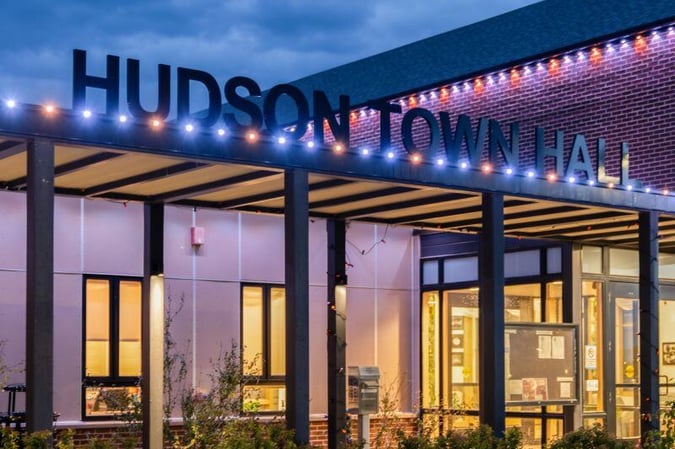
Architectural Lighting as a Civic Identity Statement
Every municipality has a visual identity composed of the buildings, streetscapes, and public spaces that give the community its character. Getting the lighting right on civic buildings is not a cosmetic exercise. It is an act of civic expression. And generic flood lighting simply is not up to that task.
Flood lighting projects a flat wash of light onto a building's surface without distinguishing between the features that matter architecturally and the ones that don't. It makes a building visible, but it does not make it meaningful. It does not reveal the cornices of a historic city hall, the proportions of a library facade, or the clean contemporary lines of a public safety building. It simply makes everything equally bright, which is the visual equivalent of saying nothing in particular.
What Architectural Integration Achieves
Architectural lighting that is designed specifically for the form and character of a building does something entirely different: it reveals the building. It traces the lines that define the structure, highlights the features that give it its character, and creates a visual presence that is specific to that building and no other. A century-old city hall with ornate cornices that are finally visible after dark. A modern public safety building whose clean roofline is defined by an even, professional glow. A historic library whose brick facade is illuminated with warm, intentional light that makes it look like the community treasure it is.
Trimlight's system achieves this level of specificity because it is installed directly into the trim, eaves, and architectural features of each individual building rather than projecting generic illumination from a distance. The result is not a building that is simply lit from outside. It is a building whose identity is enhanced and defined from within its own architecture, creating a nighttime presence that is as specific and intentional as the building's daytime character.
Consistency Is What Makes It Credible
The consistency of that identity matters in the municipal context just as much as its quality. A building that looks exceptional on some nights and dark on others sends a mixed message about the institution it houses and the community it represents. Trimlight's permanent LED lighting delivers the same quality of presentation every single night, in every season, without variation and without requiring any ongoing attention from the municipal staff responsible for managing the facility.
Public Safety: The Responsibility That Lighting Carries in Civic Spaces
For municipal buildings, exterior lighting is not merely a matter of aesthetics or institutional identity. It carries a responsibility that is fundamentally different from what applies to private properties. Civic buildings serve the entire cross-section of a community, including elderly residents navigating public spaces after dark, individuals with mobility limitations accessing essential services, children attending evening programs, and members of the public who may be unfamiliar with a building's layout and surroundings. Every one of these individuals deserves a built environment that prioritizes their safety.
The Hazards a Dark Exterior Creates
Dark zones around civic buildings create genuine and preventable hazards. Unlit pathways and parking areas are slip-and-fall risks that expose municipalities to liability. Poorly lit entrances create navigation challenges for visitors who are unfamiliar with the building. Shadowed perimeters create security vulnerabilities that affect both staff and community members who use the space after hours. Each of these conditions is not just a safety failure. It is a failure of the public trust that municipalities are responsible for upholding.
How Trimlight Addresses These Vulnerabilities
Trimlight's outdoor security lighting, integrated permanently into a building's architectural exterior, addresses these vulnerabilities comprehensively. The coverage is complete and consistent, reaching the full perimeter of the building. It is automatic, activating every evening without depending on a staff member to switch it on. And it is permanent, meaning there are no gaps in coverage due to seasonal removal, equipment failure, or the gradual degradation that affects temporary lighting systems over time. A civic building with Trimlight is never the dark building on the block. It is always the lit one, and that distinction matters to every person who relies on it after hours.
Beyond physical safety, the deterrence value of consistently lit civic buildings deserves particular attention. Public buildings that house sensitive records, expensive equipment, and public property are not immune to vandalism and property crime. Well-documented research in criminology consistently demonstrates that consistently lit exterior perimeters deter criminal activity far more effectively than intermittently lit or unlit ones, because consistent lighting signals active oversight and eliminates the conditions that make opportunistic crimes possible.
For municipalities that carry the legal responsibility of maintaining safe public spaces, the liability reduction associated with permanently eliminating dark zones around civic buildings is a practical and financial benefit that complements every other operational advantage Trimlight provides. A well-lit building is a safer building, a less vulnerable building, and a building whose municipality can demonstrate it has taken reasonable steps to protect the public it serves.
Seasonal Displays and the Power of Shared Civic Experience
The most visible and emotionally significant application of Trimlight's system in the municipal context may be its capacity for seasonal and holiday programming. Traditional approaches to municipal outdoor Christmas light installation are labor-intensive, logistically complicated, and surprisingly expensive when all costs are fully accounted for.
Crews must be scheduled for installation and removal. Equipment must be inventoried, maintained, and stored between seasons. Budget must be set aside each year for replacement components and repairs. And despite all of that ongoing investment, the result often varies in quality from year to year and requires the same resource commitment every single season without building any lasting value into the building's infrastructure.
How Trimlight Changes the Equation
Trimlight eliminates this cycle entirely. With the system installed permanently into the building's architecture and controlled through the Trimlight Edge app, municipal administrators can program full Christmas lighting outdoors displays weeks or months in advance, activate them automatically on the appropriate dates, and transition between seasonal palettes with a single adjustment in the app.
There is no crew scheduling, no storage management, no annual reinstallation budget line, and no variation in quality from one season to the next. The holiday display activates exactly as programmed, looks exactly as intended, and returns to the building's standard lighting when the season concludes, all without placing any burden on municipal staff.
What Shared Holiday Displays Do for a Community
The community engagement value of well-designed professional Christmas lights on civic buildings goes beyond aesthetics. When residents drive past a beautifully lit city hall or community center during the holiday season, they experience their community as one that celebrates together, that takes pride in its shared spaces, and that invests in the moments that matter most to the people who live there. That experience builds a quality of civic attachment that is genuinely difficult to create through any other means.
The same capability that enables compelling holiday displays also enables year-round civic expression. A municipality can program its civic buildings to mark community events, honor nationally recognized observances, support awareness campaigns, and celebrate local achievements through color and light in ways that are visible, meaningful, and operationally effortless. All of it is managed through the Trimlight Edge app, scheduled in advance, and executed automatically.
The Operational and Financial Case for Permanent Civic Lighting
Municipal decision-makers require every capital investment to be justified not just in terms of immediate impact but in terms of long-term operational value, maintenance burden, and cost relative to alternatives. Trimlight's commercial-grade LED system was built to meet exactly these standards.
The system is rated for tens of thousands of operational hours, which in the context of nightly use on a public building translates to years of reliable performance without the recurring costs of bulb replacement, system repair, and the labor associated with maintaining aging lighting infrastructure. For a municipality managing multiple civic facilities, the cumulative savings across all buildings represent a substantial reduction in the operational budget dedicated to exterior lighting maintenance.
Eliminating the Hidden Cost of Seasonal Cycles
The labor cost of putting up and taking down seasonal lighting across a municipality's portfolio of civic buildings is rarely fully accounted for in annual budget comparisons, but it is real and it is recurring. Every hour of municipal labor spent on ladder work, cord management, storage logistics, and equipment repair is an hour not spent on the higher-value work that civic staff are employed to do. Trimlight eliminates that cost permanently with a single installation investment.
Energy Efficiency at Scale
The energy efficiency of LED technology adds a further dimension to the financial case. Trimlight's system consumes a fraction of the energy that traditional incandescent or halogen exterior lighting requires, and across a portfolio of large civic buildings the difference in utility costs can represent meaningful annual savings. Over the course of a multi-year installation, the combination of reduced energy costs, eliminated maintenance expenses, and the removal of recurring seasonal installation budgets produces a total cost of ownership that is highly competitive with any alternative approach to municipal exterior lighting.
Historic Buildings and the Demand for Precision
Many of the most significant civic buildings in any municipality are also among its most architecturally and historically significant structures. A century-old city hall, a historically designated public library, a government building that has anchored a downtown for generations: these structures have proportions, materials, and architectural details that deserve to be revealed and honored rather than flattened by poorly conceived illumination.
How Trimlight Works With Historic Architecture
Trimlight's precision installation model is well suited to the specific demands of historic civic architecture. Because the lighting is integrated into the building's existing trim and architectural features rather than projected onto the exterior from a distance, it works with the building's form rather than against it. The warmth and controllability of the LED output can be calibrated to complement the building's materials and historical character without overwhelming them.
For municipalities subject to historic preservation requirements or the oversight of architectural review commissions, the fact that Trimlight's installation is minimally invasive and reversible is a critical consideration. The system can be integrated into existing architectural details without permanent modification to the building's fabric, making it compatible with the preservation standards that govern how historically significant civic structures can be modified. A building that has served a community for a hundred years can now present itself after dark with the same dignity and intentionality that its architects envisioned for it in the daylight, without compromising the integrity that makes it worth preserving in the first place.
The result is a historic civic building that finally looks after dark the way it deserves to look: defined, intentional, and unmistakably present. Residents who have walked past the same building for decades often describe seeing it lit by Trimlight for the first time as a genuinely moving experience, because the building they have always known in daylight reveals a presence after dark that they never knew it had. That revelation is one of the most uniquely civic benefits that Trimlight delivers, and it is only possible through the precision and sensitivity of an architecturally integrated permanent system.
Managing Multiple Buildings With a Single System
One of the most operationally significant advantages of Trimlight's system for municipalities managing multiple civic facilities is the ability to coordinate and control the lighting of all of them through a single platform. The Trimlight Edge app supports centralized management across multiple installations, allowing a single administrator to adjust programming, coordinate seasonal displays, and respond to special circumstances across the entire municipal portfolio without requiring physical access to each individual building.
Holiday programming can be deployed consistently across all civic buildings simultaneously, ensuring that the municipality presents a unified and professional seasonal identity. Observances and community events can be reflected across all civic buildings at once, amplifying their visual impact and the community's sense of shared participation in the moment being recognized.
A Phased Approach That Works
For municipalities considering a phased approach to permanent civic lighting, beginning with the highest-profile buildings and expanding over time, Trimlight's system accommodates that approach without creating management complexity. Each building's installation operates independently and is fully functional on its own, while also integrating seamlessly into the centralized management platform. The municipality can expand its civic lighting footprint at whatever pace its budget allows, with the confidence that each installation will meet the same professional standard and that the end result will be a cohesive, municipality-wide lighting identity rather than a patchwork of unrelated systems installed at different times.
This scalability is a meaningful advantage for municipalities that are managing multiple capital priorities simultaneously and need to demonstrate responsible budget stewardship at every step. A phased Trimlight installation allows a municipality to show visible, meaningful progress in its civic presentation with each building that comes online, building community support and institutional momentum toward a fully realized civic lighting strategy that serves the entire community for years to come.
The Standard Your Community Deserves
Municipal buildings carry a weight of civic meaning that no other category of structure quite matches. They are where communities come together, where public decisions are made, where essential services are delivered, and where the identity of a place is most visibly expressed. The standard to which these buildings are maintained and presented is a direct reflection of how seriously a municipality takes its responsibility to the people it serves, and that standard is on display every evening to every resident and visitor who passes by after dark.
Trimlight gives municipalities the tools to ensure that standard is always being met, consistently, professionally, and without placing an ongoing operational burden on the staff and resources responsible for managing public facilities. From the holiday light installations that bring a community together during the seasons that matter most, to the outdoor security lighting that ensures public spaces are safe and accessible during evening hours, to the architectural illumination that gives every civic building a nighttime identity worthy of its daytime significance, Trimlight delivers a solution that serves every dimension of a municipal building's after-dark needs.
The communities that invest in how their civic buildings look after dark are the ones that understand something fundamental about what public spaces are for. They are not just functional. They are symbolic. They tell a story about the community's values, its ambitions, and its commitment to the people it was built to serve. Trimlight ensures that story is always being told clearly, consistently, and with the kind of professional quality that every community has every right to expect from its public institutions. The impression a municipal building makes lasts long after the evening ends. With Trimlight, that impression is always the right one.
Frequently Asked Questions
How does permanent exterior lighting improve public safety around civic buildings?
Consistent architectural lighting eliminates the dark zones around civic buildings that create physical hazards and security vulnerabilities, ensuring that public spaces are safely navigable for all residents during evening hours without depending on staff to activate it.
How does Trimlight compare to hiring a seasonal lighting company for annual displays?
Unlike seasonal installations that require annual setup, removal, and recurring labor costs, Trimlight's permanent system delivers consistent, professional displays every season automatically once it is installed, with no scheduling or crew management required year after year.
Is permanent outdoor lighting cost effective for municipalities with limited budgets?
Yes. The combination of LED energy efficiency, commercial-grade durability, and the elimination of recurring seasonal installation costs produces long-term operational savings that make a permanent system significantly more cost effective than traditional approaches over the life of the installation.
Can Trimlight be used on historically significant civic buildings?
Yes. Trimlight's installation integrates directly into a building's existing trim and architectural details with minimal invasiveness, making it compatible with historic preservation requirements while giving the structure a beautifully intentional after-dark presence.
What does the installation process look like for a municipal building?
An authorized Trimlight dealer conducts an initial consultation, assesses the building's architecture and lighting objectives, and completes a professional installation that permanently integrates the system into the building's trim and roofline, leaving it fully programmed.
How do we get started with Trimlight for our municipal facilities?
Connect with an authorized Trimlight dealer near you to schedule a consultation. The dealer will assess your buildings, discuss your civic lighting objectives, and design a permanent system that meets your community's needs and budget requirements.